Essay
The field
I wanted a field that could remember, respond to touch and observe what it was doing. Here is how it works, and how you can rewire it.
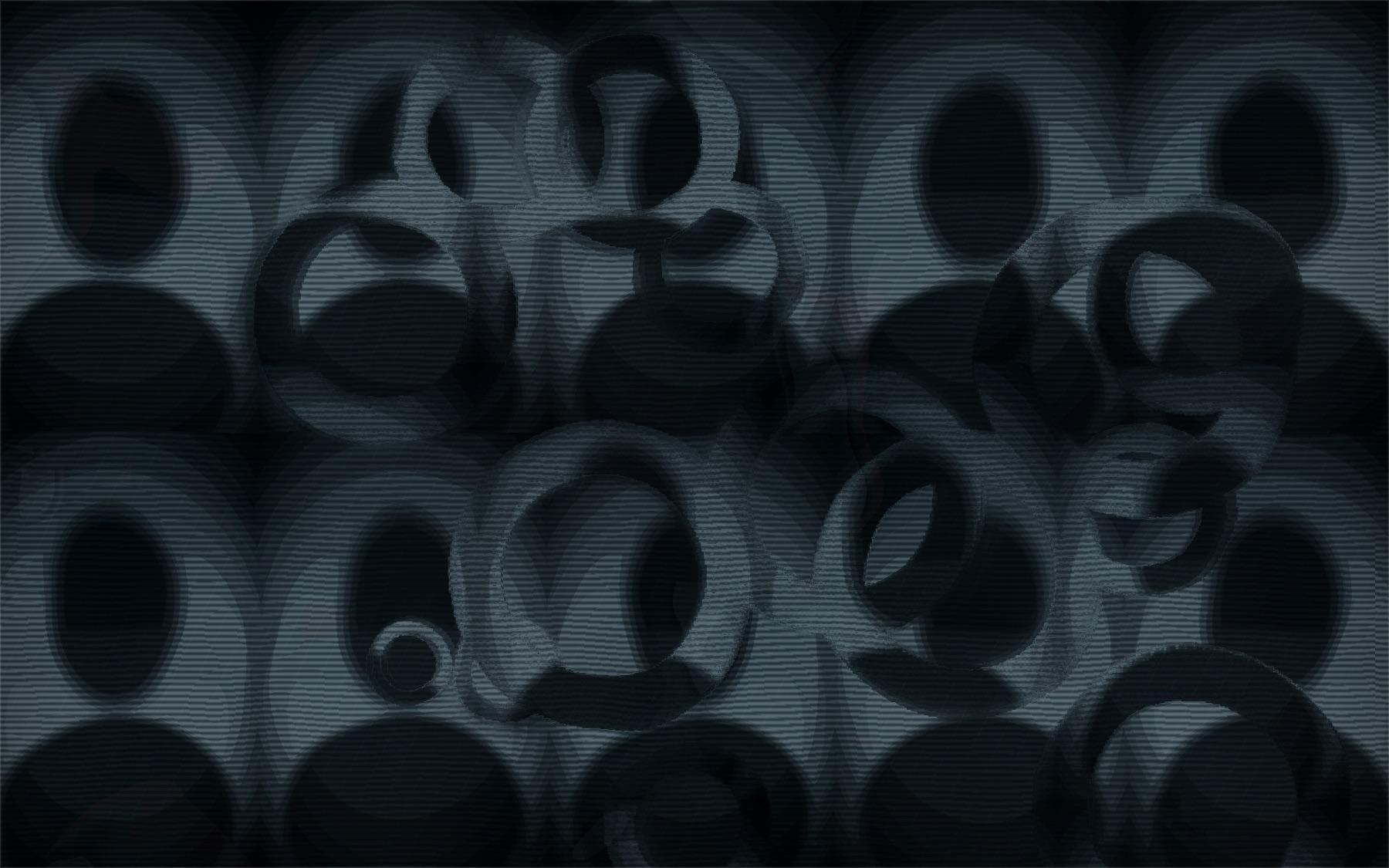
The field at the top of my homepage is drawn live, frame by frame, by your browser. It is written in Hydra, the live-coding video synth created by Olivia Jack. I wanted a small experiment on my site: somewhere to explore shaders, how much a deterministic system can change, and what makes a tool interesting to use. I asked for three things: it should remember, it should be different on every visit, and it should respond when you touch it.
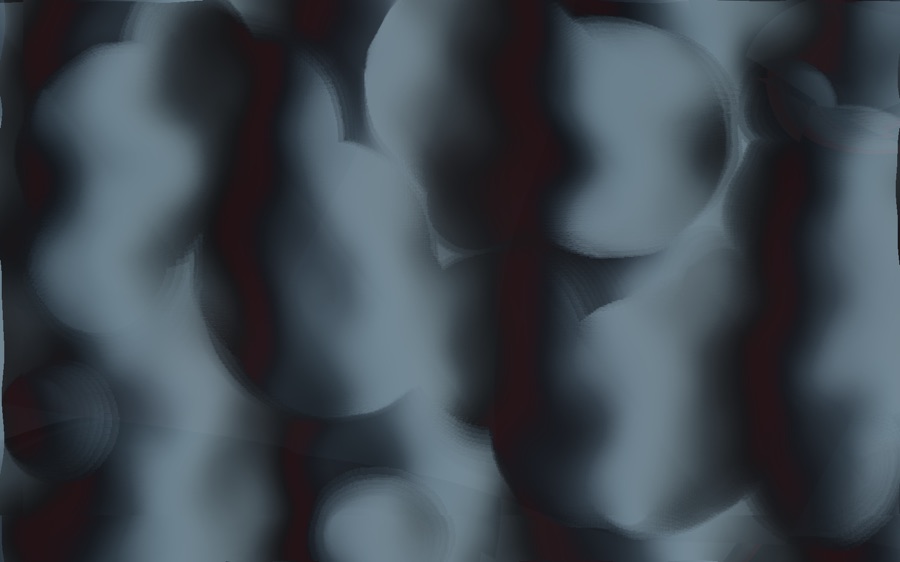
Every sketch began with a song. I keep a playlist for the site, and for each track I imagined the Hydra sketch it could become, then translated it into code in conversation with a coding model. I wanted slow movement and something atmospheric, ambiguous, almost scientific. When a sketch looked too familiar as generative art, I asked for something denser and more restrained. Each visit starts with one sketch and one of its seven variations; Another sketch chooses a new one.

It remembers
Moving over the field leaves traces, and pressing leaves stronger ones. At first a trace was a sparkle that followed the pointer. I wanted it to keep doing something after I had moved away. Memory sets how slowly traces fade, from under a second to twenty. A few of them are kept on your device and return on your next visit.
It has a place
I’m based in San Francisco, so the field follows the time and weather there, for everyone. It doesn’t need to ask where you are. Daylight follows the local hour, and a faint sun crosses the image during the day. Wind pushes the finished image downwind; cloud cover softens its contrast.
On 18 September 2026, while I was building the field, I pulled an Oblique Strategy: “Abandon normal instruments.” I asked the coding model how it could map onto the field. The normal instruments were the pointer and the sliders the panel had then, so it suggested letting something that isn’t a control play the sketch: the weather, the words on the page, or nobody at all. I chose the weather. The sketches already belonged to their songs, so weather doesn’t choose the visual. It changes the finished frame, and you can give it a bigger role through the patch.
You can rewire it
Hydra treats visuals like a modular synthesizer: sources and transformations are patched together, and the connections decide what happens. That is Olivia Jack’s idea. The patch panel extends it across the field’s sketches, so you can take the image from one, bend it with another’s distortion, and let its trails follow the contours of a third.
Image chooses what is drawn, Bent like the distortion, Driven by what sets its strength, and Trails along the contours that carry the previous frame. The driver can be your pointer, Memory, San Francisco’s wind, cloud or daylight, or the field’s own Order and Motion, passed through as Steady, Eased or Swell. A trace beside it shows the last six seconds, so you can see your choice take effect.
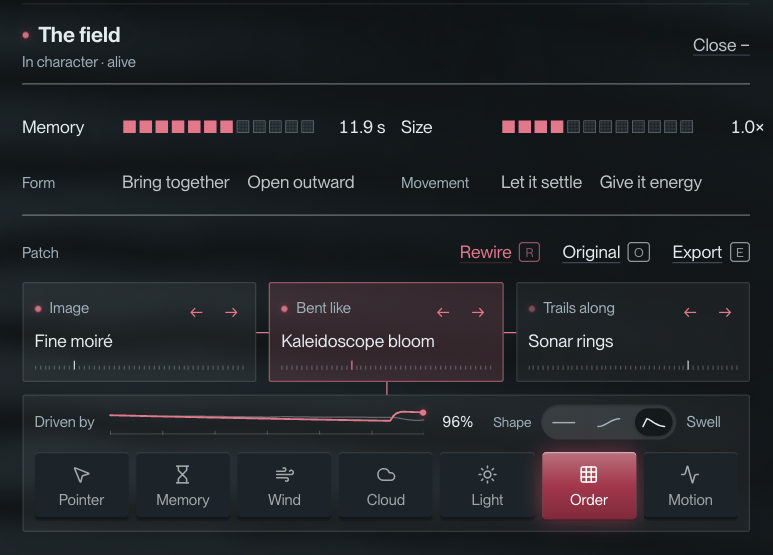
Every patch has a written form. Export shows it as a line in the patch language, or copies it as a sketch that runs in Hydra’s own editor:
src(fine-moire, 6).bend(kaleidoscope-bloom, order.swell()).trail(sonar-rings).out(o1)
It watches itself
An early version had an entropy slider. I could move it, but that only told the system what I wanted. I wanted it to look at what it was actually doing.
Once or twice a second, the field looks at a small copy of its own image and measures two things: how much its edges agree on a direction, and how much it has changed. These are Order and Motion. Brightness alone would miss what I cared about; a smooth gradient has many brightness values and is still highly ordered. The readings are compared with the sketch’s own recent behaviour, not a universal score, and the panel puts them in words: gathered, in character or open; settled, in rhythm or alive.
Those readings can drive the bend. Then the image changes according to its own structure, which changes the next reading, which changes the bend again.
You can also ask it for a change: Bring together or Open outward, Let it settle or Give it energy. It adjusts in small steps, checks the result, and reports what happened. Sometimes it gathers; sometimes it holds its shape. That difference between what I asked for and what the system could do is what interests me most. The response should describe the result, even when it falls short of the request.
Try it
- Open Change the field on the homepage.
- In Patch, use the arrows or drag sideways across a part to choose a visual, then pick a driver and watch the image and the trace respond.
- Rewire (R) changes one part, Original (O) restores the sketch’s own wiring, and Export (E) copies the patch or a runnable Hydra sketch.
A patch lasts until you choose another sketch or leave the page. If your device asks for reduced motion, the field rests and the patch controls are hidden. I still need to see whether someone meeting the field for the first time can understand it without reading this.
Thanks
The field stands on other people’s work. It is drawn with Hydra, created by Olivia Jack and kept alive by a community of contributors. Its idea of patching comes from analog modular synthesis; Hydra’s own guide illustrates it with Dan Sandin’s Image Processor, an analog video synthesizer from the 1970s. The field runs on hydra-ts, folz’s TypeScript fork of Hydra, and regl by Mikola Lysenko. “Abandon normal instruments” is one of Brian Eno and Peter Schmidt’s Oblique Strategies. And every sketch began with someone else’s song.